Testing Bitcoin As Inflation Hedge
An analysis of bitcoin's correlation with CPI and market inflation expectations from 2015 to 2026 reveals a surprising disconnect between bitcoin's fixed supply and its actual price behavior.

Bitcoin & Markets | Nov 11, 2026
Independent bitcoin analyst of 12+ years, exploring bitcoin and monetary evolution. Subscribe today, and please consider joining the Pro tier for my weekly Rogue Missives every Friday, covering the most important macro developments shaping markets around the world!
Bitcoin Is An Inflation Hedge, Right?
One of bitcoin's most important memes is that it serves as an inflation hedge, but is that borne out in the data, is what we want to know.
Theoretically, bitcoin should be an excellent inflation hedge. Its supply is fixed at 21 million coins, while the dollar supply can expand indefinitely. If bitcoin is priced in dollars that are continually losing purchasing power, its dollar price should rise over time, all else being equal.
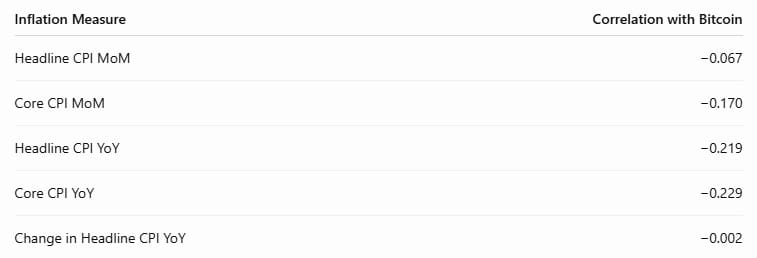
Yet, when I compared monthly bitcoin returns against headline and core CPI inflation from February 2015 through October 2026, I found weak negative correlations across the board.
Interestingly, the relationship has changed over time. During 2019–2022, bitcoin was negatively correlated with inflation, but since 2023, that relationship has turned positive. Core CPI MoM went from a correlation of −0.367 to +0.415.
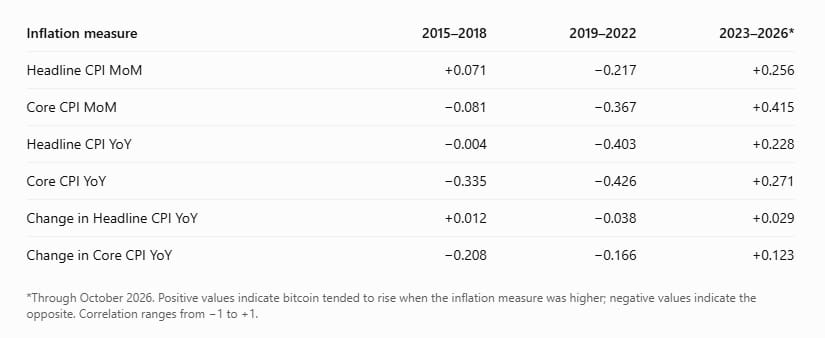
What does this actually mean? It means bitcoin's monthly price changes have very little correlation with CPI inflation. The inflation-hedge narrative implies a strong positive relationship: when inflation is high or accelerating, bitcoin should perform better. But some of the strongest correlations in our analysis are actually negative. Higher inflation has tended to coincide with weaker bitcoin returns, and vice versa.
Bitcoin's fixed supply clearly does not automatically translate into price appreciation when consumer prices rise. Instead, marginal supply and demand appear to overwhelm any simple relationship between bitcoin's price and consumer inflation.
Bitcoin may still protect against long-term monetary debasement, but the data does not support the claim that it reliably protects investors against rising consumer prices. Its value as an inflation hedge lies more in its independence from CPI than in any direct positive correlation.
Annual Returns Tell a Similar Story
For consistency, I also compared December-to-December changes in bitcoin prices and CPI. This measures bitcoin's annual price appreciation against inflation over the same calendar year.
The result is similar: bitcoin's annual returns remain negatively correlated with both headline and core CPI inflation. Extending the measurement interval from monthly to annual returns does not reveal the positive relationship we might expect from a conventional inflation hedge.
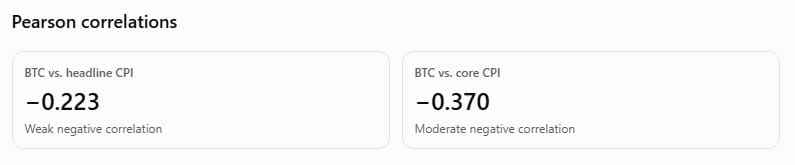
CPI is, of course, not monetary inflation. Studies of M2 show periods of positive and negative correlation as well. Specifically, the last few years have been negative. In a future post, I'll look at productivity vs the bitcoin price. That will be interesting because bitcoin could perform well during periods of improving productivity and falling inflation. Such an environment would make bitcoin look like a poor CPI hedge even if its performance were associated with improving economic fundamentals.
Subscribe to not miss that.
Inflation Expectations Then?
Pearson correlation between monthly bitcoin returns and monthly changes in market-implied inflation expectations, measured in basis points.
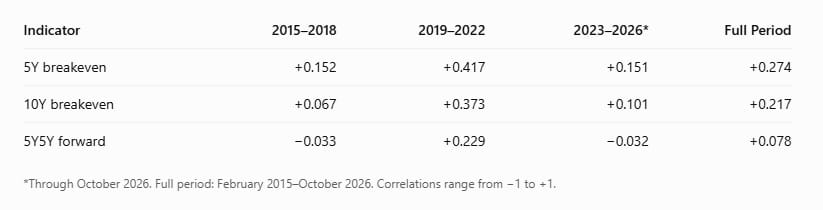
Bitcoin shows a stronger relationship with changes in market-implied inflation expectations than with actual CPI inflation, but that relationship is neither particularly strong nor consistent over time.
Correlations peaked during 2019–2022, with the 5-year breakeven reaching +0.417, before falling substantially after 2023. Most striking is the near-zero correlation with the 5Y5Y forward inflation rate, which measures longer-term inflation expectations. Bitcoin appears more sensitive to cyclical shifts in inflation expectations than to changes in the market's long-term inflation outlook. This challenges the conventional inflation-hedge narrative.
If bitcoin's price were primarily driven by expectations of future dollar debasement, we'd expect a stronger relationship with long-term inflation expectations. Instead, the data suggests bitcoin's price is influenced more by broader macroeconomic and financial conditions than by inflation.
Conclusion
Is bitcoin an inflation hedge? Not against CPI, according to the data. Bitcoin's price has shown little consistent relationship with consumer price inflation.
As I've argued for years, CPI is not monetary inflation. Over the last six years, consumer prices have been heavily influenced by supply constraints, first from COVID, then the war in Ukraine, and most recently the Iran conflict. Energy uncertainty has been a major factor, while the AI revolution has further muddied the signals of real growth and inflation.
Bitcoin may still be a hedge against monetary debasement, but not against CPI.
HODL strong. Thanks for reading! PLEASE SHARE!
A
- Podcast links and Socials
- Disclaimer
- Feedback form
- Original charts and analysis are CC-BY