PMI Just Flashed a Major Bitcoin Buy Signal
The last two times PMI hit 55 starting an economic expansion bitcoin went parabolic!

Bitcoin & Markets | August 3, 2026
Independent bitcoin analyst of 12+ years, exploring bitcoin and monetary evolution. Subscribe today, and please consider joining the Pro tier!
Make sure to sign up for the Pro tier to receive my weekly Rogue Missive every Friday, covering the most important macro developments shaping markets around the world.
Clarity Act Update
They have until Friday to pass the Clarity Act before the Senate leaves for recess. Whether they actually take that recess remains uncertain. There are procedural maneuvers underway to keep the Senate in session long enough to pass the SAVE Act.
Regardless, price is our barometer. If the Clarity Act looks likely to pass, we should see a sustained breakout above $67,000 and progress toward $80,000. While there’s some renewed bullishness in the price action, passage by the end of this week still doesn’t look particularly likely.
Previous Bitcoin Price Models
I’ve written about the relationship between bitcoin and the Purchasing Managers’ Index over the last few months. I believe it is one of the most important indicators added to bitcoin price analysis in years.
First came the halving theories and ideas about a potential deflationary spiral. During bitcoin’s early growth, the market became capable of absorbing the new supply created by the block reward. When the block reward was cut in half but growing demand still wanted large amounts of new bitcoin, price had to adjust upward. That rise then created additional demand because bitcoin behaves partly like a Veblen good: higher prices can make it more desirable.
The halving effect has weakened over time because each reduction in new issuance represents a smaller shock relative to bitcoin’s existing stock and the size of the market.
I’m still partial to what came next as a primary predictor of price, Stock-to-Flow. Even though it failed as a precise price model, its underlying economic reasoning remains directionally sound. Scarcer assets should command a higher value when demand is stable or rising.
After Stock-to-Flow lost influence came the Power Law. I’m indifferent to the Power Law, but it seems to have the most adherents now. I did a write-up on it as well. The Power Law is based on price history, so its parameters have also been adjusted as new price data has come in.
There are many more indicators built from internal bitcoin data, like realized price, HODL waves, and MVRV. But what’s missing from all of them is a connection to the underlying economy.
Prices are relative to each other, and financial conditions are always changing. A rationale for why the bitcoin price moves is at least as important as describing how it has moved, because the character of those price movements can change over time.
PMI COMES IN HOT!
A year or two ago, several analysts began comparing bitcoin bull markets with the Purchasing Managers’ Index, or PMI. This indicator is based on a survey of purchasing managers from around the country. Respondents report whether business conditions such as new orders, production, employment, and inventories improved, remained unchanged, or deteriorated from the previous month. Those responses are combined into a diffusion index, with readings above 50 generally indicating expansion and readings below 50 indicating contraction.
This morning, we got a blazingly hot PMI.
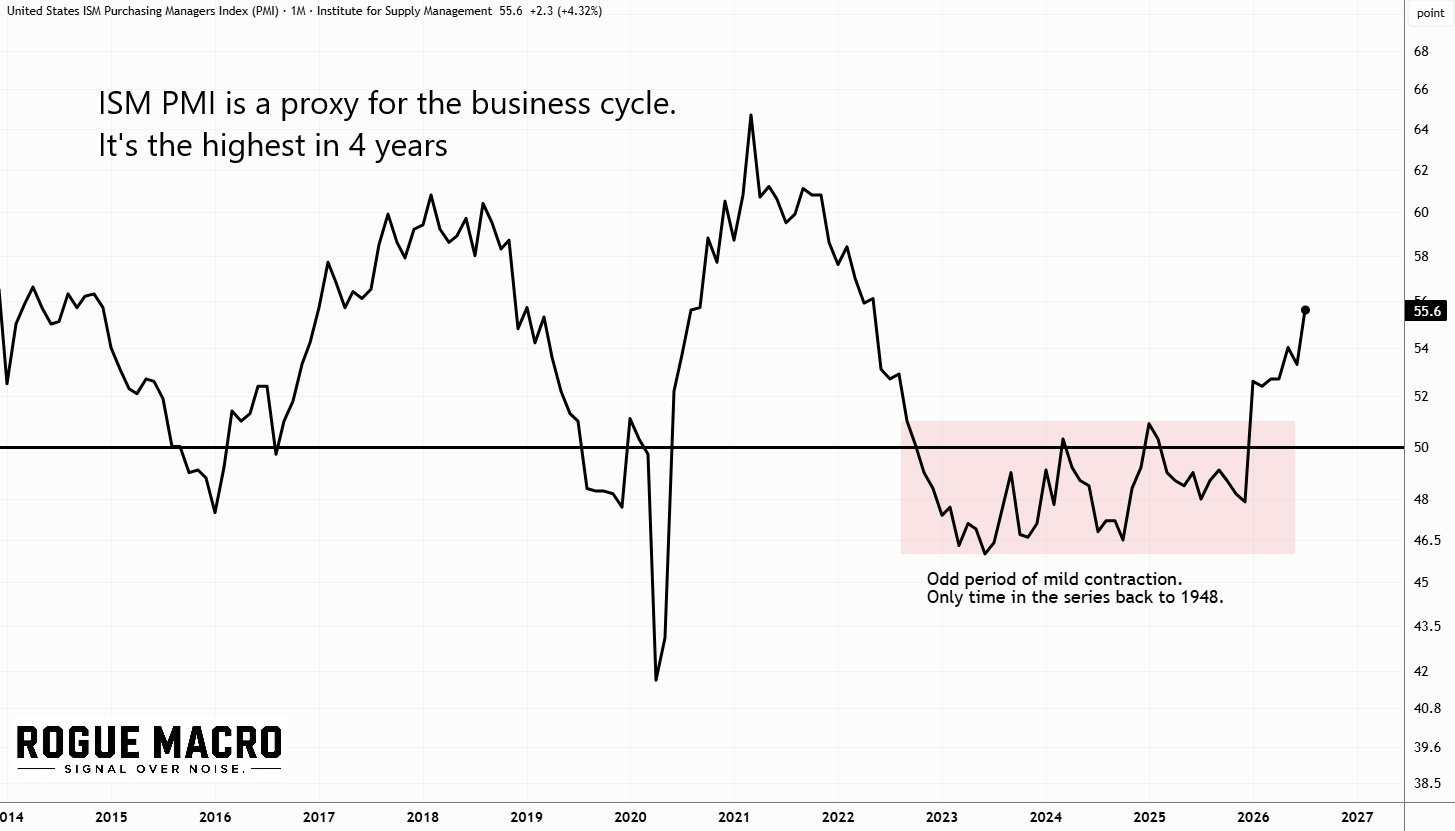
I’ve argued that bitcoin did not have an actual bull market in 2023-2025. The price increase was instead the cumulative result of the halving, the launch of spot ETFs, and the rise of bitcoin treasury companies like MSTR. Those were powerful bitcoin-specific catalysts, but they did not occur within a truly expansionary economic environment.
However, now look at PMI! Estimates were for a reading of 53, but the index shocked analysts by coming in at 55.6. This is looking more and more like a real economic breakout.
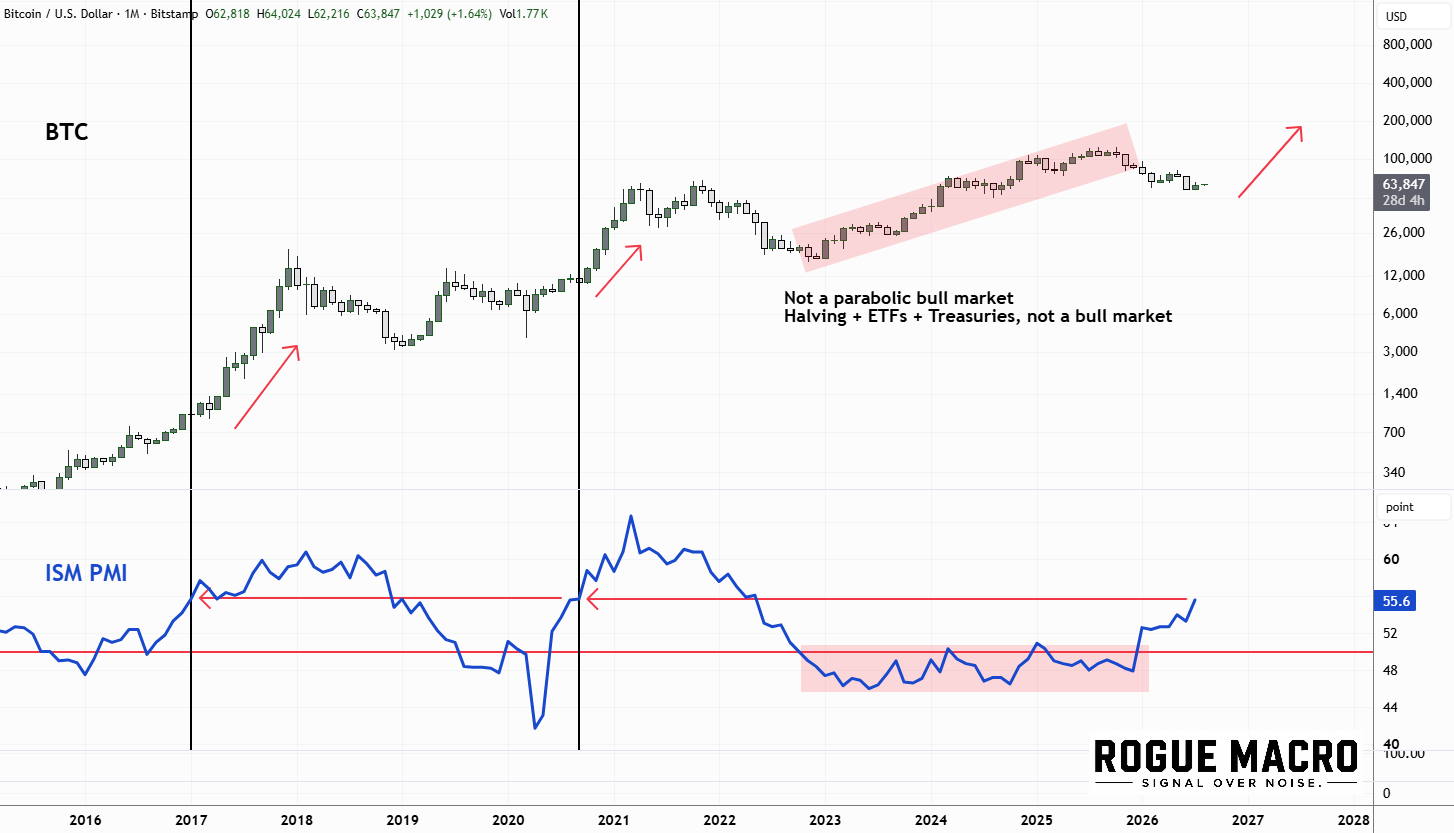
Under these conditions, bitcoin should have a much stronger macro tailwind. For the first time in this cycle, bitcoin-specific demand could be combining with a genuinely expanding business cycle. If PMI continues rising and bitcoin can break decisively above $67,000, the move toward the 200-day moving average and the major resistance zone around $80,000 could happen quickly.
The last two times PMI crossed 55 while rising, bitcoin responded with an immediate breakout and significantly higher prices. That does not guarantee the same outcome this time, but it tells us that bitcoin may be entering a very different market regime from the grinding, liquidity-constrained environment of the last three years.
That's it for this short update. Thanks for your support, and please share this with anyone you think would find it valuable.
HODL strong. Thanks for reading! PLEASE SHARE!
A
- Podcast links and Socials
- Disclaimer
- Feedback form
- Original charts and analysis are CC-BY